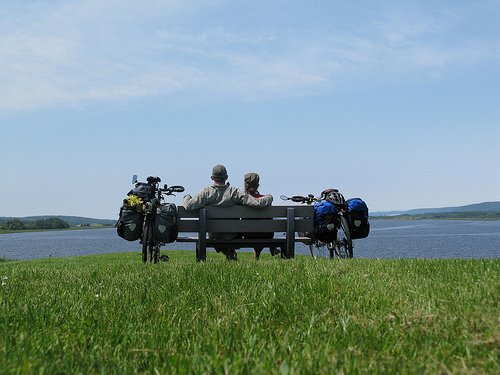
We are quite proud and a little relieved to announce that we have just conquered the last, monolithic o bstacle on our quest to Santiago (and eventually to see all of you), Paso de Agua Negra: 4780 meters. For those of you already rummaging around for a calculator, that´s 15,682 feet. This leg of our journey was the greatest point to point elevation gain we´ve made in the shortest amountof time. We started from approximately 600 meters above sea level and completed the climb (190 km)in three days...Thats over 30,000 feet of elevation gained and lost! Eat that, Lance Armstrong! Our journey upward was energized and motivated by the ongoing parade of fan club members that passed us by with waves, smiles, thumbs-up, fistpumps, tobacco tin finger-slaps, musical honks and applause. There were few passersby that didn´t at least give us a friendly wave. A river followed us most of the ride up the canyon, collecting snow melt from the capped peaks and melting (too bad) glaciers. The mountains were void of vegetation, but full of electric colors, contrasting golds, red
 s and shades of grey. We fell under the good graces of the wind gods for most of the climb, until about 15km from the top of the pass, when hurricane force winds blasted us head-on and we struggled to keep ourbikes upright and moving in a forward direction. One slow kilometer and hairpin turn after another, we arrived at the international border with tears of joy in both of our eyes and a little less breath in our lungs. We struggled to keep from being blown off the mountain as we took photos before bundling up for the steep descent. The next morning, we awoke frozen to the bone and rode in hats, mittens and down jackets until the sun rose above the mountains a few hours later. We abrubtly met the infamous Pacific-to-Andes wind that we had been hearing so much about. Sure, w
 e can handle wind, we thought. At least we´re going downhill. Ha Ha! Not much is worse for the psyche than struggling (hard) to pedal downhill. We passed fairly efficiently through Chilean customs and immigration and rode nearly 100km down, into the wind. Beaten, battered and hungry, we pulled over to locate the first town on the map to buy food. (At this point, we were completely out of food less the powdered milk, tea and mermelada that wasn´t confiscated by customs). A car pulled over to ask us if we wanted help and they ended up turning around and 4 adults peeled out. They offered us water, bread, cheese and Cola de Mono, a drink like Bailey´s Irish Cream, to give us energy they told us. They invited us to stay at their house and this time, we took them up on the offer. So, we bustled as fast as we could another 30km, found their house in the dark and they offered up the greatest hospitality. They sent us away this morning,with cheese, homemade apricot jam, bread and fruit. We feel so grateful. Incredibly, the second Chilean we met today invited us to his house, too! We have just seen the P
 acific Ocean from La Serena, about 500km north of Santiago. We plan to hit the beach and indulge in a little Chilean seafood and wine this evening. We are thrilled to be here. You wouldn´t believe the amount of fruits and vegetables in season! We thought we saw a lot of grapes in Argentina. There is little earth that is not covered in them here. As we rode down yesterday, the valley looked like Jean-Claude and Christo´s fabric wrapping, because they hang curtains of fabric over the vineyards to protect them from the wind and sun. Our panniers are currently filled with strawberries, plums,watermelon and lots of veggies. They probably won´t last through the night. Anyway, that´s enough from the Chilean coast. We look forward to seeing you all soon. Put the champagne on ice...we´re coming soon to an airport near you!
 bstacle on our quest to Santiago (and eventually to see all of you), Paso de Agua Negra: 4780 meters. For those of you already rummaging around for a calculator, that´s 15,682 feet. This leg of our journey was the greatest point to point elevation gain we´ve made in the shortest amountof time. We started from approximately 600 meters above sea level and completed the climb (190 km)in three days...Thats over 30,000 feet of elevation gained and lost! Eat that, Lance Armstrong! Our journey upward was energized and motivated by the ongoing parade of fan club members that passed us by with waves, smiles, thumbs-up, fistpumps, tobacco tin finger-slaps, musical honks and applause. There were few passersby that didn´t at least give us a friendly wave. A river followed us most of the ride up the canyon, collecting snow melt from the capped peaks and melting (too bad) glaciers. The mountains were void of vegetation, but full of electric colors, contrasting golds, red
 s and shades of grey. We fell under the good graces of the wind gods for most of the climb, until about 15km from the top of the pass, when hurricane force winds blasted us head-on and we struggled to keep ourbikes upright and moving in a forward direction. One slow kilometer and hairpin turn after another, we arrived at the international border with tears of joy in both of our eyes and a little less breath in our lungs. We struggled to keep from being blown off the mountain as we took photos before bundling up for the steep descent. The next morning, we awoke frozen to the bone and rode in hats, mittens and down jackets until the sun rose above the mountains a few hours later. We abrubtly met the infamous Pacific-to-Andes wind that we had been hearing so much about. Sure, w
 e can handle wind, we thought. At least we´re going downhill. Ha Ha! Not much is worse for the psyche than struggling (hard) to pedal downhill. We passed fairly efficiently through Chilean customs and immigration and rode nearly 100km down, into the wind. Beaten, battered and hungry, we pulled over to locate the first town on the map to buy food. (At this point, we were completely out of food less the powdered milk, tea and mermelada that wasn´t confiscated by customs). A car pulled over to ask us if we wanted help and they ended up turning around and 4 adults peeled out. They offered us water, bread, cheese and Cola de Mono, a drink like Bailey´s Irish Cream, to give us energy they told us. They invited us to stay at their house and this time, we took them up on the offer. So, we bustled as fast as we could another 30km, found their house in the dark and they offered up the greatest hospitality. They sent us away this morning,with cheese, homemade apricot jam, bread and fruit. We feel so grateful. Incredibly, the second Chilean we met today invited us to his house, too! We have just seen the P
 acific Ocean from La Serena, about 500km north of Santiago. We plan to hit the beach and indulge in a little Chilean seafood and wine this evening. We are thrilled to be here. You wouldn´t believe the amount of fruits and vegetables in season! We thought we saw a lot of grapes in Argentina. There is little earth that is not covered in them here. As we rode down yesterday, the valley looked like Jean-Claude and Christo´s fabric wrapping, because they hang curtains of fabric over the vineyards to protect them from the wind and sun. Our panniers are currently filled with strawberries, plums,watermelon and lots of veggies. They probably won´t last through the night. Anyway, that´s enough from the Chilean coast. We look forward to seeing you all soon. Put the champagne on ice...we´re coming soon to an airport near you!


 Although Bolivia was a quick passing in our Latin America riding adventures, it was spectacular at times, frustrating at others and deserves a closer look into the inner workings of its day to day business transactions. Outside of the cities, the scenery was breathtaking and suprisingly free of the litter that pervades LA. We rode through landscapes that reminded us of the desolation of Nevada, the canyons of Arizona and the red rock formations of Utah. Along this stretch of deserted road to the Salar Uyuni in SW Bolivia, only three cars passed in our direction in three entire days. The road was very challenging as we pushed our bikes through sand, shook and girated through washboard and screamed (Kirsten) obscenities as we humped our bikes back and forth from the horrible main road to the nearly as horrible frontage road.


